


The Quantum Opportunity: Building Southern California's Future
Education, Workforce Development, and Regional Partnerships for the Next Technology Revolution

In 2022, I wrote two Technolink articles introducing readers to the rapidly emerging world of quantum technologies. The first explored the impact that quantum computing and post-quantum cybersecurity could have on our digital future, while the second examined the growing need for education and workforce development as governments, universities, and industry began investing heavily in Quantum Information Science. At that time, quantum technologies were still viewed largely as research projects with tremendous long-term potential.
Four years later, the conversation changed.
Today, the question is no longer whether quantum technologies will become commercially important. Instead, organizations around the world are asking how quickly they can prepare the workforce, partnerships, and infrastructure needed to support what many now call the Second Quantum Revolution. Figure 1 shows the progression from the start of the first quantum revolution to where we are now.

Figure 1: The Two Quantum Revolutions — A timeline from the transistor and laser to quantum computing, networking, sensing, and cybersecurity.
While quantum computing continues to capture public attention, equally important advances are occurring in quantum communications, quantum networking, quantum sensing, integrated photonics, and quantum-secure communications. Collectively, these technologies have the potential to transform computing, telecommunications, healthcare, aerospace, defense, manufacturing, scientific research, and many other sectors over the coming decades.
The challenge is no longer simply developing the technology. The challenge is preparing people to use it.
Why Southern California?
History has shown that technology revolutions are not built by individual discoveries alone. They flourish where research institutions, industry, entrepreneurs, educators, government, and investors work together to transform scientific breakthroughs into practical products and thriving businesses.
Southern California has done this before.
The aerospace revolution helped establish the region as a global leader in aviation and space technologies. Advances in semiconductors, lasers, fiber optics, biomedical devices, telecommunications, and more recently artificial intelligence have continued to strengthen one of the most diverse high-technology economies in the world.
The emerging quantum economy builds naturally upon these existing strengths.
Our region is home to internationally recognized universities, a vibrant aerospace and defense industry, leading semiconductor and photonics companies, advanced telecommunications infrastructure, a growing AI ecosystem, and one of the nation's largest community college systems. These organizations already possess decades of experience in optics, lasers, fiber optics, precision manufacturing, electronics, computer science, and systems engineering, the very disciplines that underpin Quantum 2.0 technologies.
Rather than starting from scratch, Southern California has an opportunity to build upon capabilities that already exist. Figure 2 shows the next step is connecting these organizations into a coherent quantum ecosystem.

Figure 2: Southern California's Quantum Ecosystem — Universities, community colleges, industry, government, professional societies, and startups connected through workforce development and collaboration.
Building the Workforce
One of the most encouraging developments since my previous articles has been the growing recognition that the quantum workforce will require far more than physicists and computer scientists.
The emerging industry will depend upon optical technicians, photonics engineers, fiber-optic specialists, software developers, manufacturing engineers, laboratory technicians, cybersecurity professionals, educators, applications engineers, and business leaders who understand how quantum technologies can solve real-world problems.
Preparing this workforce requires collaboration across the entire educational pipeline. Students first become interested through K–12 STEM programs, continue developing technical skills at community colleges and universities, and then expand their expertise through internships, professional societies, and continuing education as technology evolves.
Professional organizations such as the Optical Society of Southern California (OSSC), along with universities, community colleges, industry, and government agencies, all have important roles to play in building these pathways. Figure 3 shows a diagram of the quantum workforce development pathways that are being established.
Over the past several years, I have been fortunate to contribute to this effort through educational outreach, participation in national workforce initiatives, presentations at conferences and schools, and planning activities for the proposed Quantum Optics Institute of Southern California (QOISC). The institute is envisioned as a collaborative education and applied research organization where students, teachers, researchers, and industry professionals can learn together through classroom instruction, hands-on laboratories, and partnerships with universities and industry.
The objective is not simply to create another educational institution.
It is to strengthen the regional ecosystem that already exists.
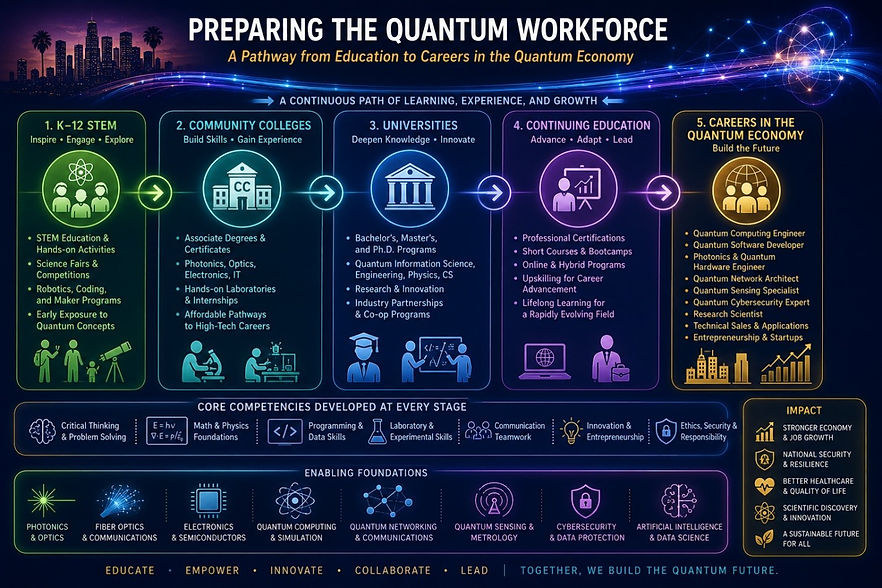
Figure 3: Preparing the Quantum Workforce — A pathway illustrating K–12 STEM, community colleges, universities, continuing education, and careers in the quantum economy.
Quantum Networking: Beyond Quantum Computing
Although quantum computing often dominates the headlines, I believe quantum networking may become one of the earliest quantum technologies to affect everyday life.
Around the world, researchers and companies are successfully transmitting quantum information over existing optical fiber networks, laying the groundwork for future quantum-secure communications and distributed quantum computing. These efforts build upon decades of investment in classical fiber-optic infrastructure and demonstrate how photonics continues to play a central role in the evolution of quantum technologies.
This year, I had the opportunity to present ideas on quantum workforce and ecosystem development at the U.S. Department of Energy Office of Science Advisory Committee's Quantum Information Science Community Town Hall. One message was clear: regional collaboration among universities, industry, educators, and government will be essential if the United States is to remain competitive in this rapidly developing field.
Southern California is well positioned to participate in this effort. Figure 4 shows the how quantum networks are being developed along with quantum cybersecurity applications.
With its extensive research universities, telecommunications infrastructure, and strong photonics community, our region has the expertise needed to contribute to the development of future quantum networking technologies.
Quantum Cybersecurity: Preparing Today for Tomorrow
One of the most important applications of quantum technology continues to be cybersecurity. In my first Technolinks article, I discussed how sufficiently powerful quantum computers could eventually compromise many of today's public-key encryption systems and why governments and industry were beginning to prepare for that possibility.
Today, that preparation has become much more tangible.
Organizations responsible for protecting critical infrastructure, financial systems, healthcare records, government communications, and intellectual property are actively planning their transition to post-quantum cryptography (PQC), new encryption algorithms designed to resist attacks from both classical and future quantum computers.
Many cybersecurity experts also warn about a strategy known as "harvest now, decrypt later." Sensitive encrypted information intercepted today could be stored for years and decrypted once sufficiently powerful quantum computers become available. This possibility is driving organizations to begin assessing their cryptographic systems now rather than waiting until quantum computers mature.
At the same time, quantum technologies are providing new security tools. Quantum Key Distribution (QKD), which uses the laws of quantum physics to detect eavesdropping during the exchange of encryption keys, represents one example of how quantum communications may strengthen future cybersecurity.
For technology leaders, the message is clear: understanding post-quantum cryptography and developing a long-term migration strategy is becoming an important part of responsible cybersecurity planning.
Looking Ahead
Technology revolutions are ultimately defined not only by scientific discoveries, but by the people who transform those discoveries into practical tools that improve lives and strengthen the economy.
The semiconductor revolution gave us modern electronics.
The photonics revolution transformed global communications.
Artificial intelligence is reshaping nearly every industry.
Quantum technologies now represent the next chapter in that continuing story.
Southern California already has many of the ingredients needed to become a recognized leader in the global quantum economy. Our universities, community colleges, research organizations, technology companies, professional societies, entrepreneurs, and government partners each contribute important pieces of a much larger puzzle.
By strengthening collaboration across education, workforce development, research, industry, quantum networking, and cybersecurity, we have an opportunity not only to participate in the Second Quantum Revolution, but to help shape it.
The future of quantum technology is no longer a distant possibility.
It is beginning to take shape today.
I look forward to continuing this journey with colleagues throughout the Optical Society of Southern California, the Quantum Optics Institute of Southern California, our educational partners, and the broader Southern California technology community as we work together to prepare the next generation of scientists, engineers, technicians, educators, entrepreneurs, and innovators.
The quantum revolution has begun.
Now it is time to build the community that will make it successful.